
Insights
Electrifying the built environment
Turning barriers into opportunities
A development can have a credible decarbonisation strategy and still stall at the grid connection. With heat pumps, EV charging and cooling increasing demand, how much capacity will a site need, and when?
That question sits at the heart of the UK Green Building Council’s new report, Electrification of the Built Environment: Barriers & Enablers. It examines pressures on demand, networks and generation, alongside decisions developers can make to support the decarbonisation of the UK building stock.
Matching connection capacity to how a development operates
The report found that building performance is often discussed in terms of annual energy use and carbon emissions. Network operators, by contrast, need to know the maximum demand a site could place on the network at a particular time. A building can perform well annually yet create a difficult peak load.
This matters when sizing connections. Adding together the maximum demand of every system or building can produce an unnecessarily high figure if those peaks are unlikely to occur simultaneously. For a mixed-use estate, for example, office, residential and retail loads may follow different daily patterns. Measured data, realistic occupancy assumptions and tested diversity assessments give a clearer picture of coincident demand.
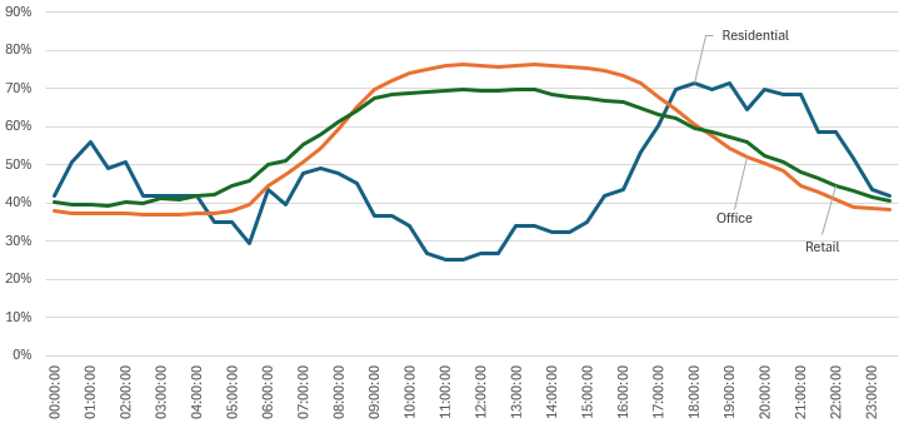
Right-sizing is about more than reducing consumption. The intention is to allow for future electrification, resilience and credible growth, with a defensible, evidence-based connection request.
Connections that work with development programmes
A multi-phase development may not need its ultimate electrical capacity on day one. Connection arrangements and reinforcement works could follow the programme rather than treating the site as one immediate load.
The report recommends early discussions with the distribution network operator, supported by phased demand forecasts, energisation dates and proposed flexibility measures, which can reveal options that a single headline capacity request might miss. A staged approach allows future capacity requirements and any necessary network reinforcement to be planned and agreed in advance, reducing the risk of unexpected and costly energisation delays.
Flexible grid connection options include:
- Actively managed connections. The network operator controls part of your demand with Active Network Management technology.
- Ramped connection. Connection capacity is increased in a phased manner based on developments build schedule.
- Timed / profiles connections. Connection capacity is subject to restrictions within specific time.
- Shared connections. Capacity can be redistributed across two or more connections if agreed by the network operator.
Reducing avoidable peaks
Once the demand profile is understood, opportunities to shift electricity consumption away from peak periods become clearer. Smart EV charging, thermal storage, battery systems and building controls can provide greater flexibility in when electricity is consumed, reducing peak demand and easing network connection constraints.
For example, rather than charging an entire fleet of electric vehicles simultaneously, smart charging systems can stagger demand throughout the day or overnight, ensuring vehicles are ready when needed without placing unnecessary pressure on the network. Similarly, thermal storage can allow heating or cooling systems to operate outside peak periods, reducing electricity demand when network capacity is most constrained.
These approaches can enable developments to accommodate increasing electrical loads within their available connection capacity, potentially reducing the need for costly network reinforcement.
Making on-site energy commercially viable
The report recommends treating on-site generation and flexibility as revenue-generating infrastructure, rather than ancillary features. Integrating on-site renewable generation with battery storage can also reduce reliance on grid electricity, manage peak demand and potentially lower energy costs. For larger developments, shared energy systems can improve the utilisation of locally generated electricity by storing surplus energy for use when demand is higher or renewable generation is limited.
However, the financial benefits of these systems do not always fall to those making the investment. In a multi-tenant building, for example, a landlord may fund rooftop solar panels while occupiers benefit from reduced electricity bills. Without suitable commercial arrangements, this can make otherwise viable investments difficult to justify.
Alternative ownership and financing models offer ways to overcome this challenge. Power purchase agreements (PPAs) can provide a revenue stream for investors while giving occupiers access to locally generated electricity. Similarly, suitable lease and service charge arrangements can clarify how costs, responsibilities and financial benefits are allocated between landlords and tenants.
By better aligning investment costs with the benefits delivered, these arrangements can strengthen the commercial case for on-site energy infrastructure and encourage wider adoption.
Recovering value from waste heat
Data centres illustrate another benefit of looking beyond the boundary of an individual asset. The report found that although they bring substantial electricity demand, they also produce waste heat that could be recovered to supply neighbouring buildings or heat networks, reducing the need for additional heating generation.
The viability of heat recovery depends on local conditions: proximity to suitable heat users, the infrastructure needed to transfer heat and the reliability of the supply. Considering these factors early, alongside clear arrangements for connection and continuity, can establish whether heat recovery has a realistic route to delivery rather than remaining a theoretical efficiency measure.
Moving forward
Taken together, these approaches offer developers more ways to respond to network constraints than waiting for reinforcement alone. Better demand data, phased planning and on-site energy may not remove every constraint, but they can support more proportionate connection strategies and better-informed investment decisions.