
Insights
Driving change with the right accreditation.

Catherine Macpherson, Director
Use your business goals to choose change-making accreditation.
As the industry evolves, so do the accreditations. With more certifications increasingly available for your buildings to achieve, it is important that developers understand how to unlock the true value of the accreditation and account for the time and money needed to achieve it before committing. If you think critically about their value versus cost and how they align with your business goals and the goals of your future client or tenant, you can make the right accreditation choices for your business.
Accreditation does a vital job. It defines what is important for how a building should perform and provides an evolving standard to show where different projects fit in the market.
BREEAM a perfect example of how they push industry improvements over time. But, whilst many accreditations do attract tenants and improve property values they can also incur both capital and running costs, increasing the risk for the contractor and committing time from all involved. This can be mitigated by thinking about your accreditation needs early on in a project, so that the criteria can be designed in.
Another common misconception is that accreditations are all purely linked to sustainability, however WiredScore and SmartScore are technology focused and the WELL Building Standards purpose is to create healthy buildings for occupants. Some of the benefits of designing for wellbeing include better air quality and moderate temperatures supporting people’s ability to work effectively and good lighting design supporting productivity and sleeping patterns. Rather than looking for a sustainability badge or a wellbeing badge, it is better to be motivated by what your business practices are and want to achieve, then identifying the accreditations that align with these goals.
How to choose the right accreditation for you
I recommend getting a good balance between value and effort. Accreditations deliver benefits, they drive up standards, improve the experience of the people in the building and cut emissions. Think about who will operate or own the asset. What do they need, what are their goals, and which accreditations support them? For example, ask: what are their net zero carbon goals as a business? Think long-term. Buildings and the systems in them last for decades, so look for accreditations that incentivise in-use, circular practices, and adaptability, so that operators and landlords can see value beyond signing on the dotted line.
BREEAM rewarding good performance
Since its launch in 1990, BREEAM has played a significant role in shaping how the industry thinks about sustainability, helping to normalise ideas that would once have been seen as optional. What’s encouraging is how it continues to evolve.
The latest version aligns more closely with whole life carbon approaches, reduces duplication with other industry standards like NABERS, and begins to move the conversation away from compliance-driven metrics like Part L towards actual operational performance. And you can’t get more than an Excellent rating if you use fossil fuels. Used well, BREEAM can be a useful framework. Used poorly, it’s just paperwork. The difference, as ever, comes down to intent and how seriously teams engage with it.
WiredScore making good practice visible
I see WiredScore as a useful design framework. For a well-designed Grade A office, most of the principles around connectivity, resilience and digital infrastructure should already be part of good practice. Where WiredScore adds value is in its simplicity. It’s relatively low cost, widely recognised, and provides a clear way of demonstrating those fundamentals to tenants, even if it isn’t strictly necessary.
SmartScore follows a smart strategy
SmartScore serves a slightly different purpose. It can be a helpful, high-level way of showing that a building has been designed to be ‘smart’, particularly for tenants who may not be familiar with the detail behind smart building strategies. The important thing is that the brief is driven by the client’s operational needs and how the building will actually be run, not by ticking boxes. SmartScore should reflect a considered smart strategy, not dictate it.
NABERS forcing the issue
For me, NABERS cuts through a lot of the noise around operational carbon. It forces us to stop talking about how buildings should perform and start dealing with how they actually do.
It makes you confront the unglamorous but critical details: how systems really operate, whether metering and controls are genuinely usable, and whether the building can be properly monitored and optimised once it’s occupied. What really matters is that NABERS doesn’t stop at practical completion. You only get a rating after a year of operation, which means performance must be proven in use, not promised at design stage. That’s a shift our industry has needed for a long time.
Of course, it demands commitment from both asset owners and tenants, and we’re still working through how that’s reflected in leases and agreements. But that discomfort is exactly why NABERS is powerful. It holds us to account and makes sure our buildings actually do what we said they would.
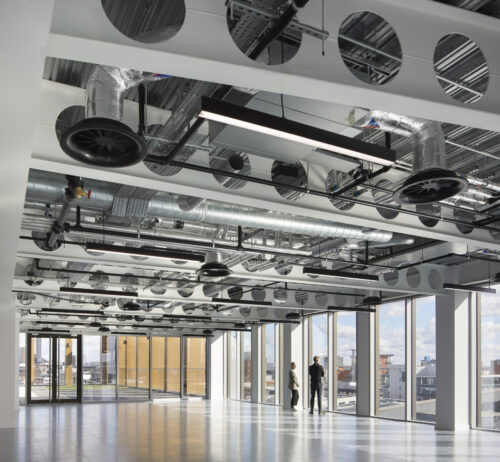
11 & 12 Wellington Place in Leeds is a good example of a project that we worked on that had a good approach to this. It is the fourth development in the UK for get NABERS Design Reviewed Target Rating of Five Stars or above and the first to achieve a NABERS UK Five Star Energy Rating following a full year of occupancy. This supports their sustainable approach that also includes sustainable commuting incentives, wildlife projects, recycling campaigns and a Greener Working Group to embed good practices and bring new ideas.
What next?
In the future I want people to have a clearer understanding about what each accreditation actually involves and what it delivers. I want organisations to step back, be selective, and understand where the real value lies rather than treating all accreditations as synonymous with being sustainable and marketable. I also want accreditations that continue to add value and push industry improvements.
LET’S TALK
CatherineMacpherson@hoarelea.com